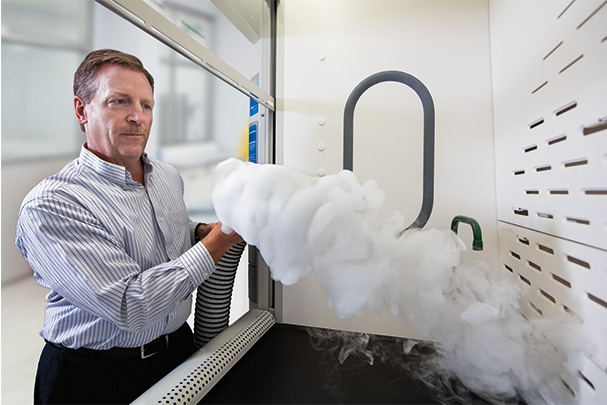
Selecting the perfect fume hood doesn’t have to be an overwhelming task. From safety, to performance, to fit – every detail matters. Simplify your lab design checklist with this quick guide to the perfect fume hood.
This quick-start guide walks you through the seven key questions every lab should ask before selecting a fume hood.
- What applications will the fume hood support?
Take some time to document the work you’ll be doing inside the fume hood. Be sure to include:
What chemicals will be used and in what volumes?
Is heat involved?
Will equipment be placed in the hood?
Most importantly, please specifically answer the following questions:
Do you work with Perchloric Acid?
Do you use Hydrofluoric Acid (HF)?
Will radioisotopes or lead bricks be used?
- What size of fume hood do you need?
This question breaks down into three parts:
Design Considerations: Consider your available space and application requirements. Common fume hood sizes include 4’ to 8’ widths.
Equipment Considerations/Dimensions: Will your hood house any equipment? If so, be sure to know the dimensions to ensure a proper fit.
Benchtop or Floor-Mounted: Applications that use extra-large equipment, such as 55 gallon drums, or applications that require equipment to be wheeled into the hood via a car, would require a floor-mounted fume hood.
- Do you require service fixtures or other accessories inside the fume hood?
These includes (but are not limited to) airflow monitors, electrical outlets, compressed air, laboratory gas, vacuum and cold-water fixtures. Gooseneck faucets are also available. Finally, do the fixtures need to be factory installed, or will the installer handle that at the job site by using field-installed kits?
- What accessories are needed outside the hood?
Think beyond the hood itself:
- Will you need a work surface and base cabinets, or will the hood sit on existing casework?
- If base cabinets are required, do you need acid, solvent, or general-purpose storage?
- Do you require ductwork from the hood to the roof, or will your HVAC contractor provide it?
- How will the fume hood be exhausted?
Every fume hood requires a blower. It is often misconceived that a blower comes included with your fume hood. Be sure to ask the following:
- Will there be a dedicated blower (exhaust fan) for this hood, or will it connect to a central exhaust system?
- If it connects to a central system, will it be constant volume or variable air volume?
If you already have a properly sized blower, you’re nearly ready to finalize your selection.
- Do you need a built-in blower or a remote blower?
Built-in blowers are easier to install, but they can be noisy, and put ductwork under positive pressure, so they should be reserved for non-hazardous applications, short duct runs and instances where a remote blower cannot be installed (such as a mobile lab).
Remote blowers (recommended) can be sized for specific installations and keep the ductwork under negative pressure for safer operations.
- What is the duct layout?
Will the duct go directly to the roof, or does it need to make some turns before reaching the roof? What diameter of duct will be used? Once the duct penetrates the roof, a final 90-degree elbow will be needed to turn the duct horizontal, then three to five feet of straight duct is needed between the elbow and blower.
Expert exhaust stack tip: Use a zero-pressure weathercap (not a gooseneck, mushroom cap or anything that would block the exhaust from discharging in a vertical, up direction) that vents upward, at least 10 feet above the roofline to allow the fumes to reach the airstream and not be returned into the building’s air handling equipment.
Ready to move forward?
Once you’ve worked through this helpful evaluation checklist, you should be better prepared to select a fume hood system that fits your lab’s workflow.
Learn More – Discover how Labconco’s Fume Hood Systems, available through Thomas Scientific, can support your lab applications.