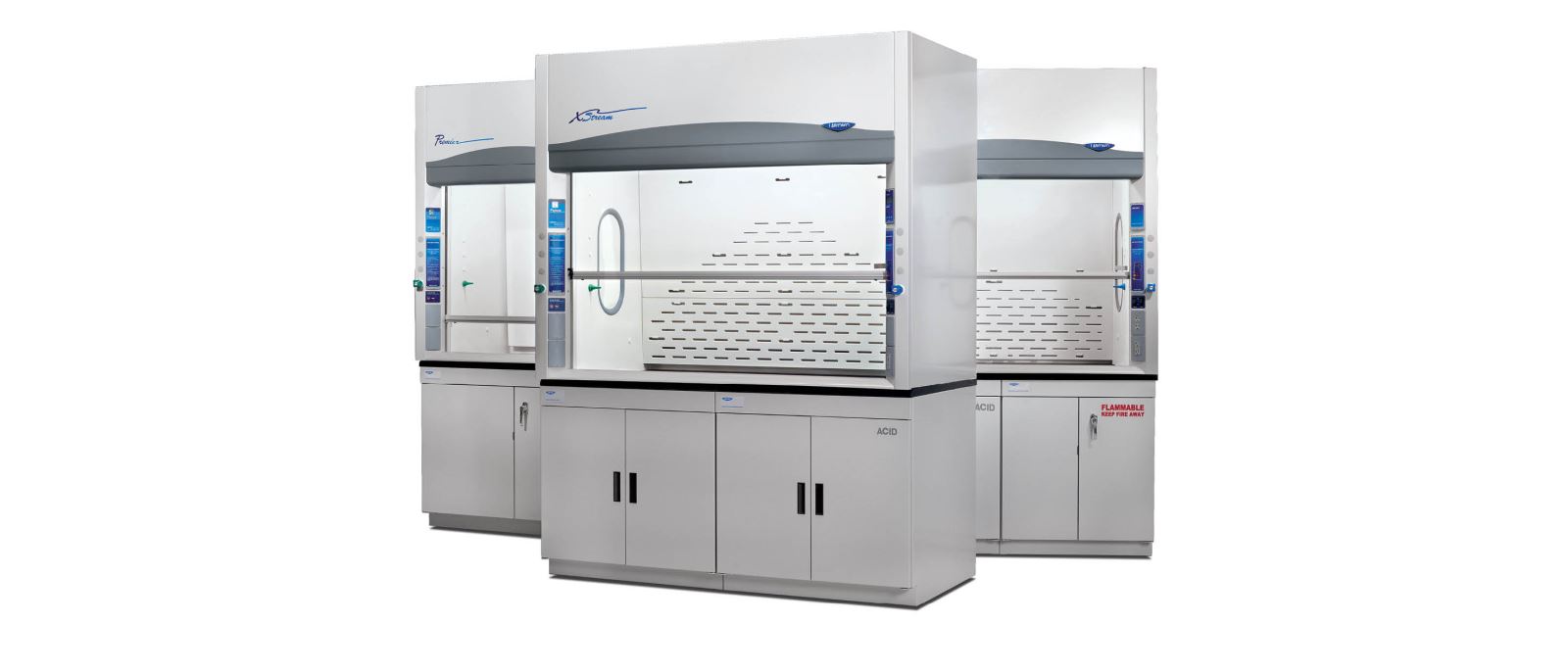
Fume hoods are designed to protect laboratory personnel by containing and exhausting hazardous chemical vapors generated during laboratory procedures. While airflow performance is often the primary focus, the interior liner material is equally important to a fume hood's long-term performance and durability. The liner serves as the primary barrier between the hood’s structure and the chemicals used inside it, making material compatibility a critical consideration.
Fume hood liners are routinely exposed to chemical vapors, elevated temperatures, moisture and cleaning agents. Depending on the application, these exposures may include concentrated acids, organic solvents, oxidizers or radioactive materials. Over time, incompatible materials can deteriorate, resulting in reduced service life, increased maintenance requirements and potential contamination concerns.
Material degradation generally occurs through corrosion, dissolution, and thermal deformation caused by excessive heat. Because no liner material is suitable for every laboratory application, selecting the proper material requires evaluating the chemicals used, operating temperatures, and expected exposure conditions.
The following sections describe the most common fume hood liner materials and their typical applications.
Epoxy Coated Steel
Epoxy coated steel liners are typically used in non-corrosive or moderately corrosive environments. Special care should be taken to avoid damaging the protective coating, as acids will quickly corrode the carbon steel if exposed. This type of liner offers excellent heat resistance and is one of the most economical liners available.
304 Stainless Steel
Type 304 stainless steel liners are often seen in applications involving work with radioisotopes. These liners typically include a stainless steel work surface, with corners and seams welded and ground to ANSI/AWS B1.11, D1.6, and A5.12 standards.
This material and method of construction provides excellent durability, supports the weight of lead shielding, is easy to decontaminate and offers static-dissipative properties.
Type 304 stainless steel has excellent moisture and heat resistance, along with good resistance to a wide range of laboratory chemicals. However, it is not compatible with some inorganic acids and metal scavengers.
316 Stainless Steel
Type 316 stainless steel liners are typically used for perchloric acid applications coupled with a wash-down system. The addition of molybdenum improves corrosion resistance compared to Type 304 stainless steel, particularly against crevice corrosion and pitting.
Type 316 stainless steel fume hood liners typically feature a stainless steel work surface with corners and seams welded and ground to ANSI/AWS B1.11, D1.6 and A5.12 standards. These liners provide excellent resistance to moisture and heat, as well as good compatibility with a wide range of chemicals. However, it is not compatible with some inorganic acids and metal scavengers.
Fiberglass Reinforced Composite Panel
Fiberglass reinforced composite panel liners are among the most common fume hood liner materials. They offer excellent chemical resistance, moisture resistance, heat tolerance and flame spread performance. Because these liners are manufactured in panels, they can be used across a wide range of fume hood models while remaining a cost-effective solution for many laboratory applications.
Molded Fiberglass Reinforced Polyester (FRP)
Molded FRP is one of the most versatile liner materials available. Unlike panelized liners, which tend to show their first signs of deterioration at the seams and joints, molded FRP is formed as a single, seamless piece. The sides, rear, roof and duct collar are manufactured as one continuous piece.
This makes typical trouble areas easy to decontaminate and eliminates the collection of corrosives at seams. Additionally, one-piece FRP liners offer superior chemical and heat resistance, even over panelized lined hoods.
Polyvinylchloride (PVC)
PVC is one of the most corrosion resistant materials used for fume hood liners. Typical applications involve acid digestion with chemicals like perchloric, hydrofluoric, sulfuric, or nitric acids. These fume hoods are typically coupled with a wash-down system.
The material used for the sash glass will vary depending on the frequency of use of these acids. Perchloric is not compatible with the organic polycarbonate, and hydrofluoric is not compatible with the more commonly used safety glass.
PVC has a working temperature of approximately 140°F, and will distort near 160°F.
Selecting the right fume hood liner is an important part of designing a safe, durable laboratory ventilation system. Understanding the chemicals, operating temperatures and maintenance requirements of your laboratory will help ensure the liner material matches your application.
Learn More
Discovery how Labconco’s Fume Hood Systems, available through Thomas Scientific can support your lab applications.